

Data Governance and Compliance: A Guide for Enterprise Users
Key points
- Data governance and compliance are related, but not interchangeable. Governance is the system of policies, processes, and tools that enterprises use to manage their data. Compliance is proving that the system meets external regulations.
- Most organizations report some form of governance over the data their AI agents have access to. Only a small percentage centrally enforce it automatically.
- Governance is the weakest where data volume is greatest. More than 90% of organizational data is unstructured, and the majority of firms report difficulty managing it, yet governed data (permissioned, current, and accessible) is exactly what AI needs to produce output teams can trust.
- Organizations report that they run several separate systems for storage, backup, and recovery, which means a single policy has to be implemented, monitored, and evidenced across each system. Governance breaks down in the gaps between them.
- Agentic AI reveals problems with data governance that were already there. Many organizations say AI has exposed gaps in their data quality or governance.
What is data governance and compliance?
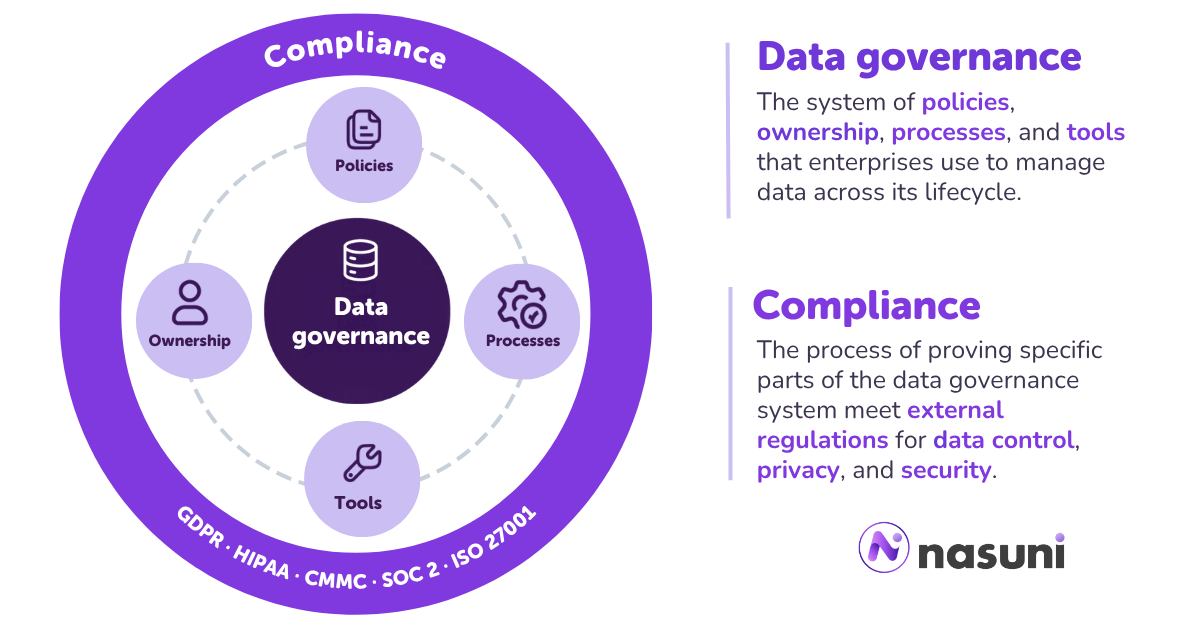
Data governance is the system of policies, ownership, processes, and tools that enterprises use to manage data across its lifecycle.
Compliance is proving that specified parts of that system meet external regulations for data control, privacy, and security.
Governance and compliance are related but not interchangeable. They often get conflated because both are frameworks that apply to a company’s data.
Think of governance as bookkeeping and compliance as the financial audit. Bookkeeping is continuous, internal, and yours to design. Audits are periodic, external, and only go well if the books are properly kept.
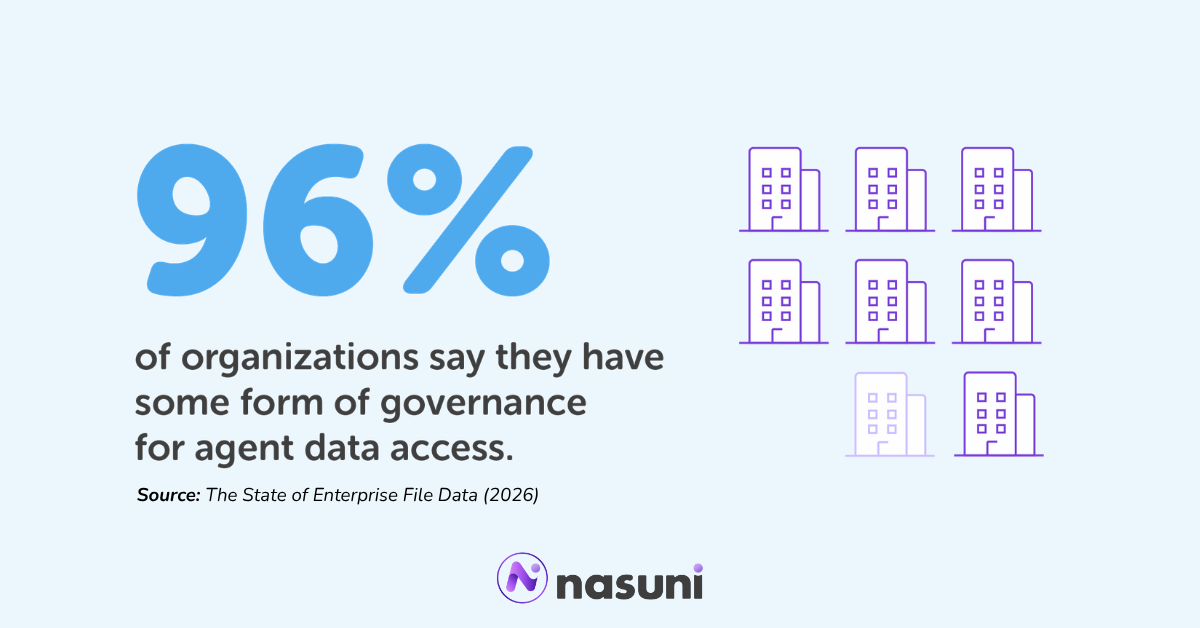
At Gartner’s 2026 Data & Analytics Summit, Director Analyst Sarah Turkaly announced that data governance would be the single point of failure for organizations’ AI ambitions. Recent research confirms her view. Nearly all organizations (96%) say they have some form of governance for agent data access, but less than a third (31%) manage that access centrally and enforce it automatically.
Data governance has historically focused on structured data, where a schema declares the type and place for every value. But over 90% of enterprise data today is unstructured files, which arrive without context attached, making them harder to index and classify. If your governance program only covers structured data, less than a tenth of your data is governed.
The seven components of data governance
All effective data governance programs share seven key components:
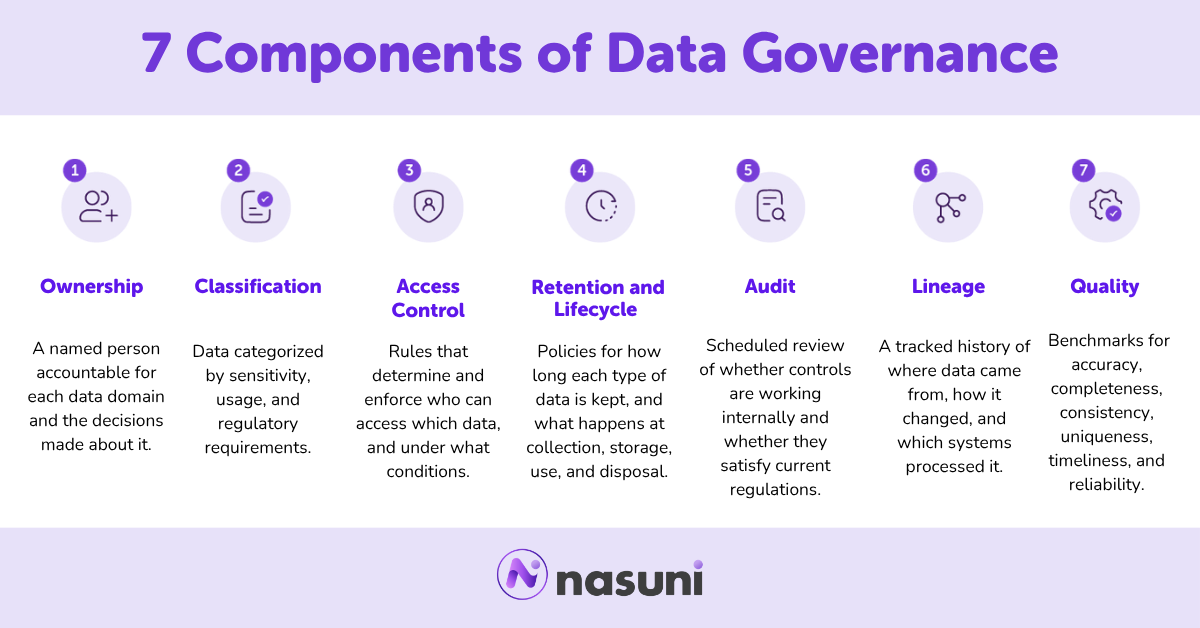
- Ownership.
A named person accountable for each data domain and the decisions made about it.
- Classification.
Data that is categorized by sensitivity, usage, and regulatory requirements. Automated data classification makes that practical when files are spread across many repositories.
- Access control.
Rules that determine and enforce who can access which data, and under what conditions.
- Retention and lifecycle.
Policies for how long each type of data is kept, and what happens at collection, storage, use, and disposal.
- Audit.
Scheduled review of whether controls are working internally and whether they satisfy current regulations.
- Lineage.
A tracked history of where data came from, how it changed, and which systems processed it.
- Quality standards.
Benchmarks for accuracy, completeness, consistency, uniqueness, timeliness, and reliability of data.
The compliance frameworks governance is measured against
Data compliance regulations ensure that organizations manage and process their data responsibly and uphold data security. Which compliance frameworks apply depends on sector, geography, and customer base. Most enterprises will be accountable to several.
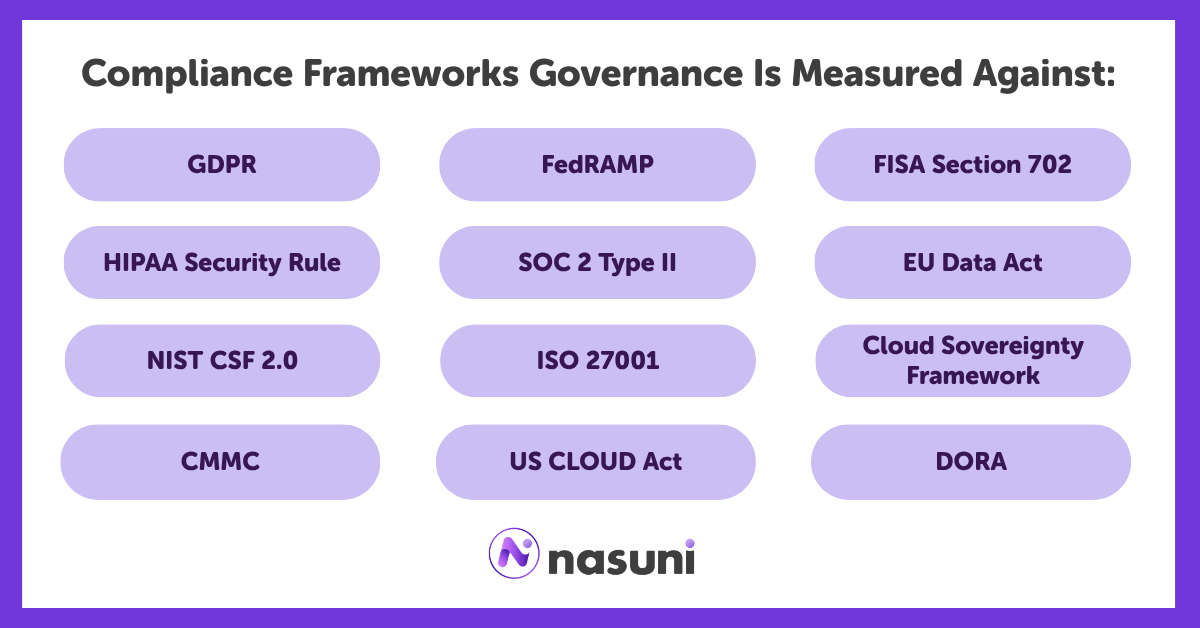
- GDPR is a data privacy and security law that governs how organizations collect, use, and transfer data relating to people in the EU.
- HIPAA Security Rule sets the administrative, physical, and technical safeguards around electronic protected health information.
- NIST CSF 2.0 is a risk management framework whose 2024 revision added Govern as a sixth function, extending cybersecurity accountability to board level.
- CMMC ranks defense contractors on how well they adhere to three levels of cybersecurity practice to determine whether they are eligible to work with the DoD.
- FedRAMP is a standardized cyber security assessment that all cloud service providers must pass to host or process US federal agency data.
- SOC 2 Type II is an AICPA standard that evaluates software businesses’ controls over customer data, over a sustained period, against five Trust Services Criteria.
- ISO 27001 certifies an organization’s information security management system through an accredited external audit that is recognized across jurisdictions.
- US CLOUD Act is a federal code that allows US law enforcement to compel US-based cloud providers to produce the data they control, even if it is stored outside the US.
- FISA Section 702 authorizes surveillance of non-US persons abroad with the compelled cooperation of a US provider. It is the regulation most frequently cited as a concern when storing regulated data with US hyperscalers.
- EU Data Act governs access to and portability of EU-generated data, including the right to switch cloud providers without punitive measures.
- Cloud Sovereignty Framework scores providers on sovereignty criteria to weight their bids in public sector procurement. Designed to strengthen the digital sovereignty of EU entities.
- DORA has been in effect since January 2025 and requires EU financial institutions to manage ICT risk across technology vendors, with mandatory incident reporting and resilience testing.
Data governance vs. data management
Data governance is often confused with data management. The two are interlinked, but not identical.
Data governance sets the rules and assigns accountability while data management carries them out. Data management is the day-to-day activity of storing, moving, protecting, and maintaining data, including unstructured data management.
Here’s how that plays out across the seven components of governance:
| Governance Component | Data governance | Data management |
|---|---|---|
| Ownership | Mandates that every data domain has an owner | Assigns the owners and handles the daily responsibility |
| Classification | Defines how data should be classified | Scans, sorts, and tags data in those categories |
| Access controls | Sets the rules for who can access data | Grants, reviews, and revokes permissions as teams change |
| Retention | Establishes how data is treated across its lifecycle | Archives, migrates, and deletes data according to that schedule |
| Audit | Requires that controls are reviewed periodically | Produces the logs and reports that make the review possible |
| Lineage | Mandates that lineage is tracked | Builds and maintains the systems that record it |
| Quality | Sets the quality benchmarks | Cleans, validates, and maintains data against those benchmarks |
The data governance vs. data management distinction also appears in where accountability sits in the organization. Data governance belongs to the board, security, legal, and the domain data owners. Data management is the domain of the CIO, and the infrastructure and operations teams.
Because the two are related, they fail together. For example:
Governance requires immutable backups of every file. But if management doesn’t carry out the backups, the organization’s data would be vulnerable during a ransomware attack, despite sound governance.
Governance requires every file to be tagged upon creation as public, internal, or confidential. Management could train operations staff to carry out the tagging. But if the governance doesn’t account for machine-generated files, then an entire category of data would go unclassified, despite well-executed management.
The policy exists in a document, the enforcement happens in a storage system, and nothing reconciles the two. But when the platform managing the data automatically applies the governance, the risk of mismatch – in either direction – declines.
Four benefits of data governance
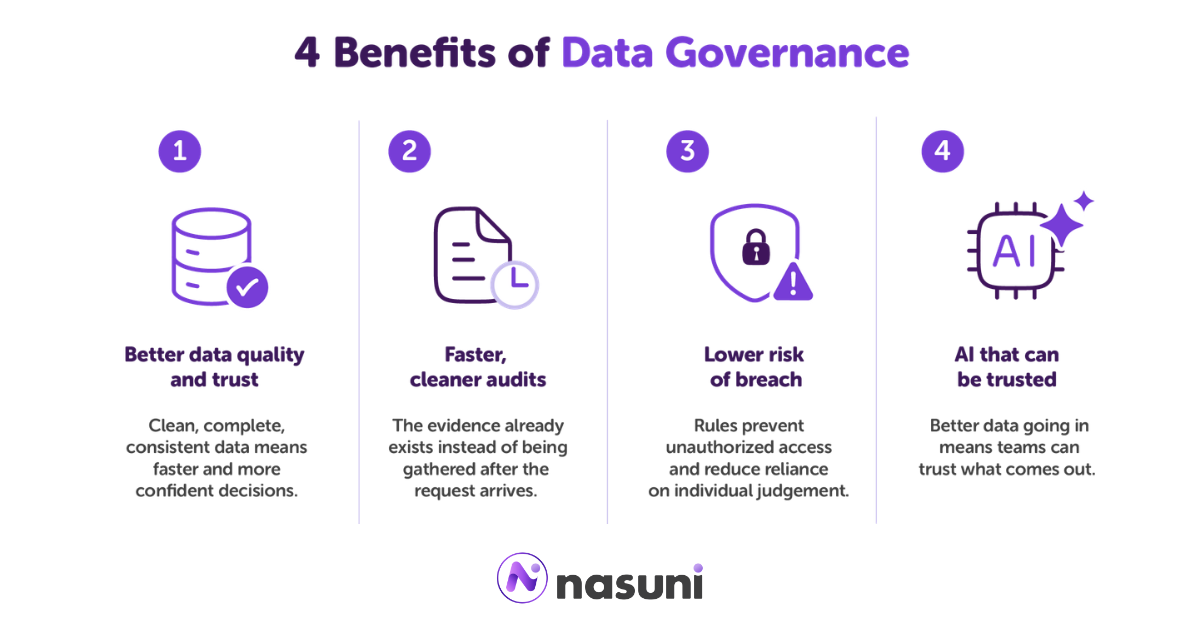
Governance serves the business, external regulators, the InfoSec team, and employees. Here are the four main benefits of data governance for enterprise teams.
-
Better data quality and trust
Data governance and quality are strongly correlated because governance requires data to be clean, complete, accurate, and consistently structured, which are all measures of quality. Teams can make faster, more confident business decisions when the data those decisions are based on is trustworthy.
-
Faster, cleaner audits
Governance produces comprehensive documentation of how data is collected, stored, processed, and protected. This paper trail means that the necessary evidence for data management compliance audits already exists, rather than having to be collected piecemeal after the request comes in.
-
Lower risk of breach
According to the State of Enterprise File Data Report, 94% of organizations worry about risks attached to file sharing, with external data leaks (45%) and accidental data loss (41%) causing most concern. The threat is a combination of external ransomware attacks and internal oversights, with the human element present in 62% of cybersecurity breaches. Governance reduces both by establishing rules to prevent unauthorized access and defining processes to reduce the reliance on individual judgement.
-
AI that can be trusted
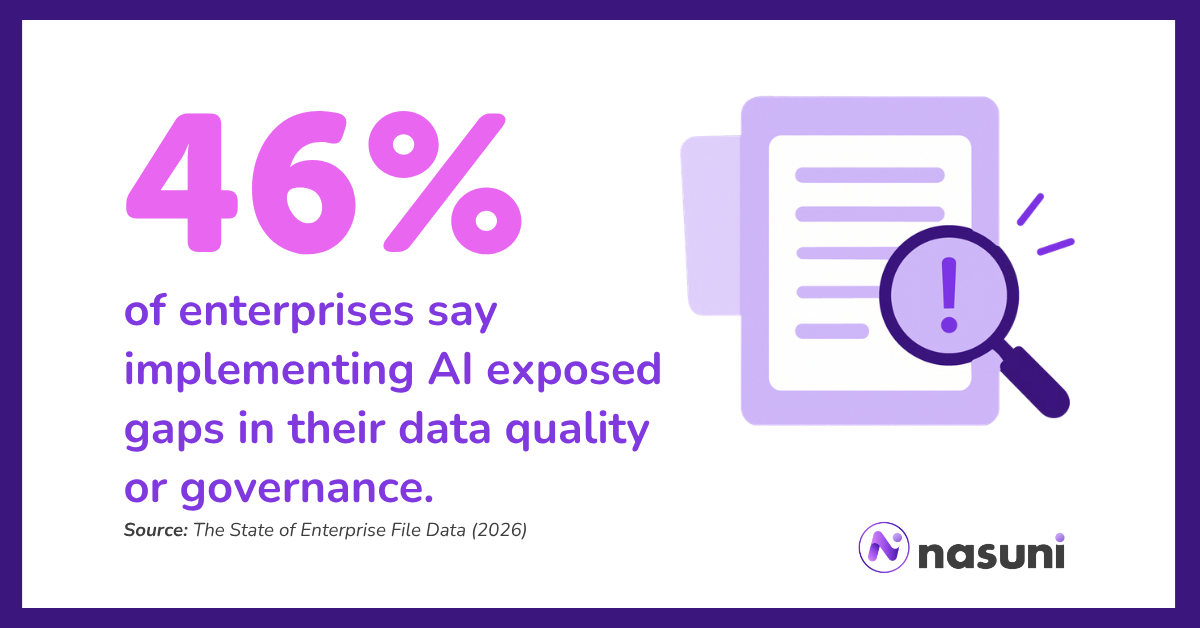
46% say that implementing AI solutions has exposed gaps in their data quality or governance. That figure rises with AI maturity, from 29% among those still piloting to 66% for those with AI embedded in processes. Governed data is accessible, well-organized, and reliable, which allows AI models to process and extract value from it. The better the data going in, the more enterprise teams can trust what comes out.
Agentic AI is now nearly universal in the enterprise: 97% say that their organizations have either deployed or are piloting AI agents. But if their data governance and compliance programs can’t match the scale and speed those agents demand, their AI initiatives won’t succeed.
Compliance and data governance use cases
The purpose of governance and obligations of compliance differ by sector. Here are four industry-specific examples of data governance and compliance in practice.
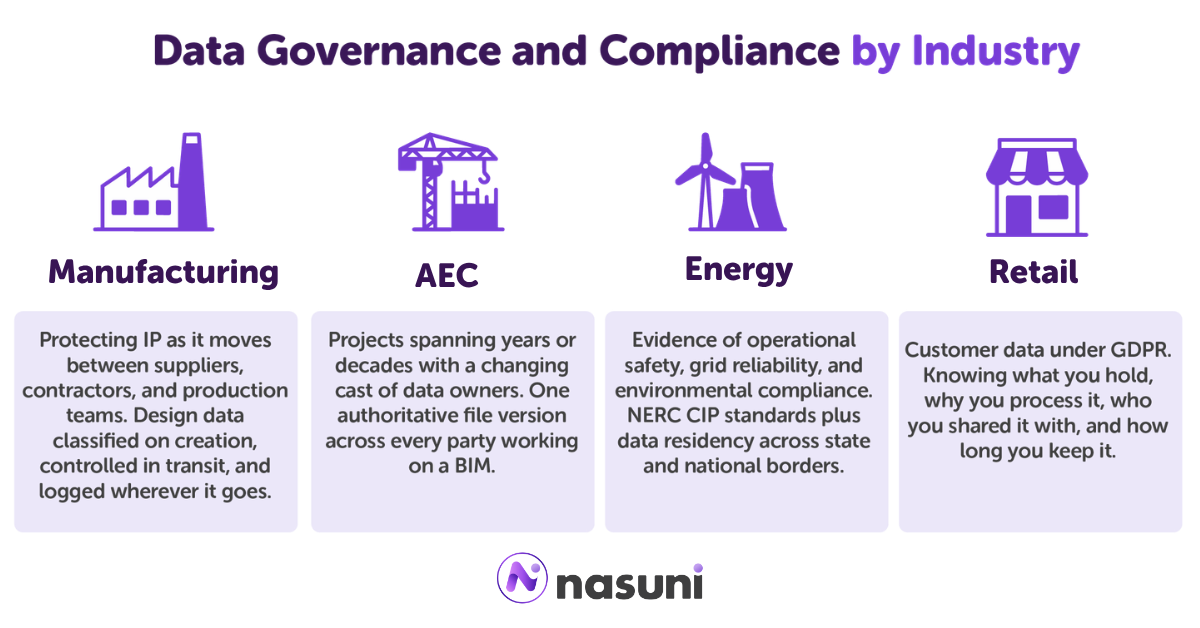
Manufacturing
In manufacturing, data governance protects intellectual property as it moves between suppliers, contractors, and production teams. Supplier collaboration puts IP at risk of being leaked, while multi-party supply chains make file version control challenging to maintain. Governance ensures that design data is classified on creation, controlled when in transit, and logged wherever it moves to reduce these risks.
AEC
In AEC, projects can span multiple years or even decades. Drawings, models, and correspondence move between clients, contractors, consultants, and suppliers over the project lifecycle. Successful AEC governance accounts for a changing cast of data owners and covers third-party data entering and moving through internal systems. It also maintains a single authoritative file version across every party working on a BIM.
Energy
Energy companies responsible for critical infrastructure require data governance to show evidence of operational safety, grid reliability, and environmental sustainability. Electric utilities must meet NERC CIP standards for asset registration, lineage, and access policies. Because networks cross state and national borders, data must be stored and processed in approved locations to meet each region’s data residency laws.
Retail
The primary concern of data governance in retail is customer data: personal information, payment details, and purchasing preferences. Under GDPR, retailers must provide, on demand, what customer data they hold, why it is being processed, who it has been shared with, and how long it will be kept. To be able to supply this information, retail data must be correctly classified, access controlled, and not retained longer than necessary.
Six data governance best practices
These six data governance best practices apply to programs at any stage of maturity.
-
Assign ownership
Give every data domain (HR, sales, product, IT, finance) a named owner. This person will be accountable for all the data under their jurisdiction and should be given authority to manage and enforce data quality, access controls, and compliance within their area.
-
Classify data
Inventory what data you hold and classify it by sensitivity, usage, business priority, and regulatory status. The categories determine which controls, restrictions, and rules apply to each piece of data and drive decisions about who can access it, how long it’s kept, and where it has to be stored.
-
Embed data policy management
Use a platform that has data policy management built-in so that data policies are enforced continually, not just when a breach hits or an audit approaches. Modern data management solutions embed controls directly into the data lifecycle, including practices such as retaining immutable snapshots of every file change or automatically detecting ransomware at the edge.
-
Make quality measurable
Establish how you will measure each of the six dimensions of data quality: accuracy, completeness, consistency, timeliness, validity, and uniqueness. Set standards, choose metrics, and define KPIs, then put mechanisms in place to ensure you meet them reliably. These could include validation rules, duplicate detection, and flagging for stale files.
-
Continuously audit
Treat your governance program as a live system. Review KPIs, conduct internal audits, and design feedback loops so that policies and processes are continually being refined. A data strategy and governance program is meant to enable business strategy, so it needs to flex with the business context.
-
Extend governance to AI
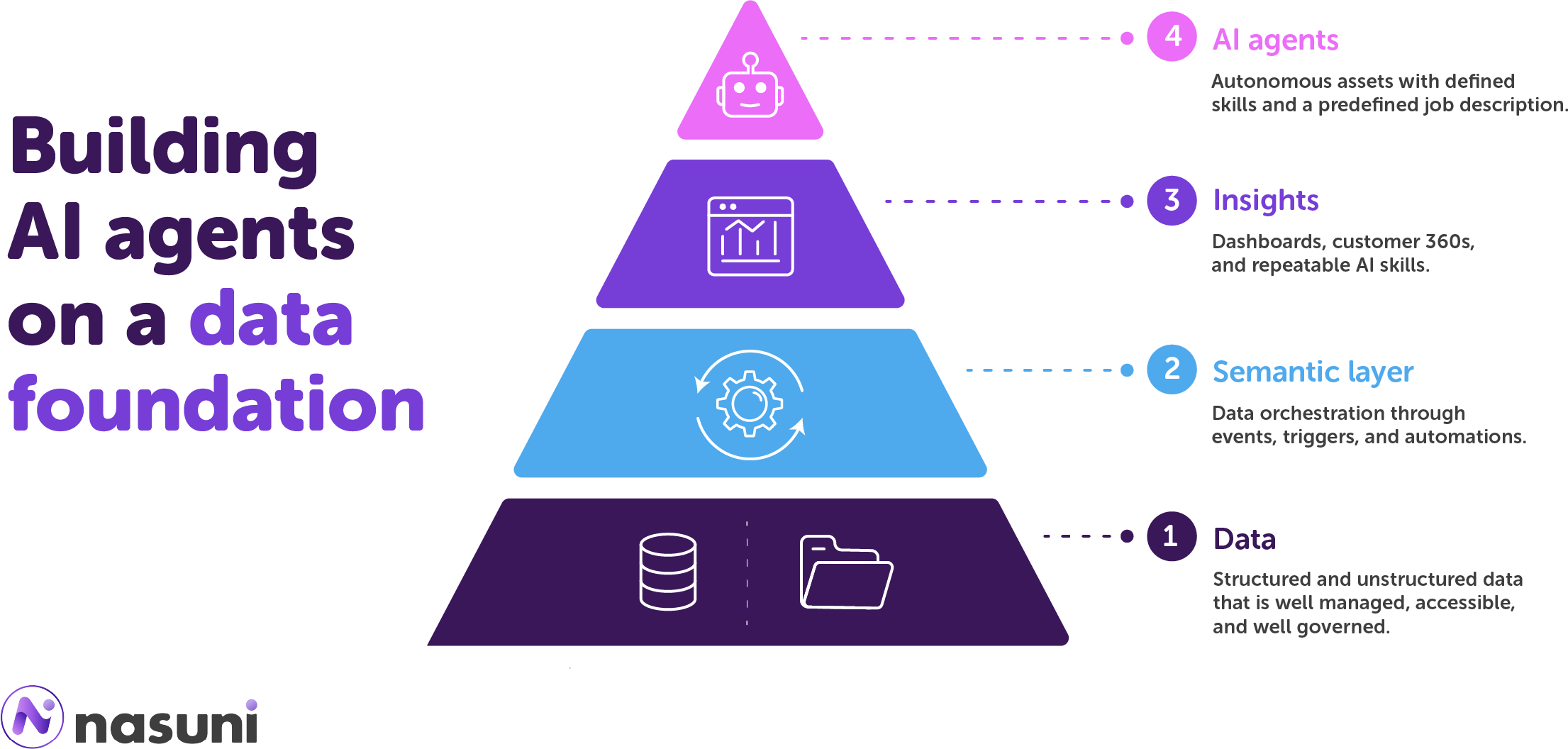
Data governance is foundational to enterprise AI strategy. Think of this as a pyramid of agentic adoption, data governance forms the base upon which orchestration, repeatable skills, and AI agents are built. Yet 76% of CIOs still say that unchecked AI is a serious concern. If an environment is over-permissioned, agents can surface information from any source, including PII and confidential data. To guard against this, agents should be governed as data users, with equivalent identities, permissions, access rules, and activity logs as human users.
How to implement data governance
The five steps below will guide you through how to implement data governance comprehensively.
-
Assess all the data you hold
Start by building a central inventory of every system, including NAS storage, file shares, cloud drives, and collaboration platforms, mapping unstructured files alongside database records. The output should be a live view of your file estate – what you have, where it lives, and its value to the business.
-
Define policies and ownership
Once you have a complete picture of your organizational data, draw up policies. These are high-level rules for how data is collected, kept, used, and shared. Assign a named data owner to each domain who will be responsible for upholding and enforcing the policies for all data under their remit.
-
Classify and prioritize by risk
Next, categorize by sensitivity, importance, and regulatory status, then rank by risk level to determine the appropriate handling. For unstructured data, that means sweeping the existing data estate and ensuring new files are tagged upon creation or ingest.
-
Enforce control at the platform level
In the State of Enterprise File Data Report, on average, organizations run four different systems for storage, backup, and recovery. That means every policy must be enforced, monitored, and proven across each system. Evaluate data management solutions that embed enforcement into the infrastructure, so rules are applied automatically.
-
Measure, audit, and adapt
Regulations change. Business priorities shift. A governance program that worked six months ago may already have gaps. To keep up, governance must be adaptable by design. Monitor leading indicators, schedule internal audits, track policy exceptions, and build feedback loops that help refine the program.
How to get started with data governance and compliance
After declaring that data governance would be the “single point of failure” for organizations’ AI ambitions, Sarah Turkaly shared her recommended strategies for enterprises to ready their governance for an AI-forward future. Her top recommendations: scale adaptive data governance, implement an integrated governance operating model, and apply technology-enforced behavioral controls.
Trustworthy AI output hinges on governed data input. If your enterprise is weighing how to get started with data governance and compliance, Nasuni can help. The Nasuni Operational File Data Platform for the AI era helps teams understand, manage, protect, and activate unstructured data from a single global namespace, with permissions enforced before AI touches a file.