

Which Data Management Trends Should CIOs Have on Their Radar? A Q&A with CIO Dalan Winbush
Nasuni CIO Dalan Winbush shares how he keeps up with unstructured data management trends and his predictions for the future of the data infrastructure space.
September 16, 2026 | Dalan Winbush
Technology development now moves on a three-week cycle of innovation. That makes predicting where the market will go next more valuable – and harder – than ever. In this Q&A, Nasuni CIO Dalan Winbush shares how he keeps up with trends in unstructured data management, why he changed his approach to agentic AI, and his predictions for the data-driven workplace of the future.
Q: How do you stay ahead of unstructured data management trends to predict what’s coming next?
There are three vehicles I use to try and stay ahead. I don’t always manage it, because the space is moving so fast.
1. I watch CNBC every day and track the big movers in the technology markets: IPOs, M&As, emerging themes. That gives me a 30,000 ft view and helps me understand where investors and companies are leaning. I combine that with reading the Wall Street Journal, Harvard Business Review, and CIO.com, plus sources like Reddit and Hacker News, to put the technology market in context of the wider geopolitical landscape.
2. I have a Claude project that gives me a daily readout. One part is for prioritizing my personal calendar. Another suggests the topics coming up that week or month that Claude thinks I’ll be interested in based on everything it knows about me: what I do, how I think, and questions I’ve asked.
3. I have peer groups of other CIOs and CTOs, who I talk with regularly. There’s no substitute for that human-to-human interaction for surfacing things that might just not have occurred to me otherwise.
Across all of it there’s a common thread. I’m always thinking about the implications for unstructured data. How could this impact data risk, data governance, and data management?
Q: Are there any trends that you’ve jumped on too soon?
Last year we leaned in hard on AI agents. But we were so focused on getting agents out the door that we forgot about the important ingredients underneath: data resiliency, data accessibility, and data governance.
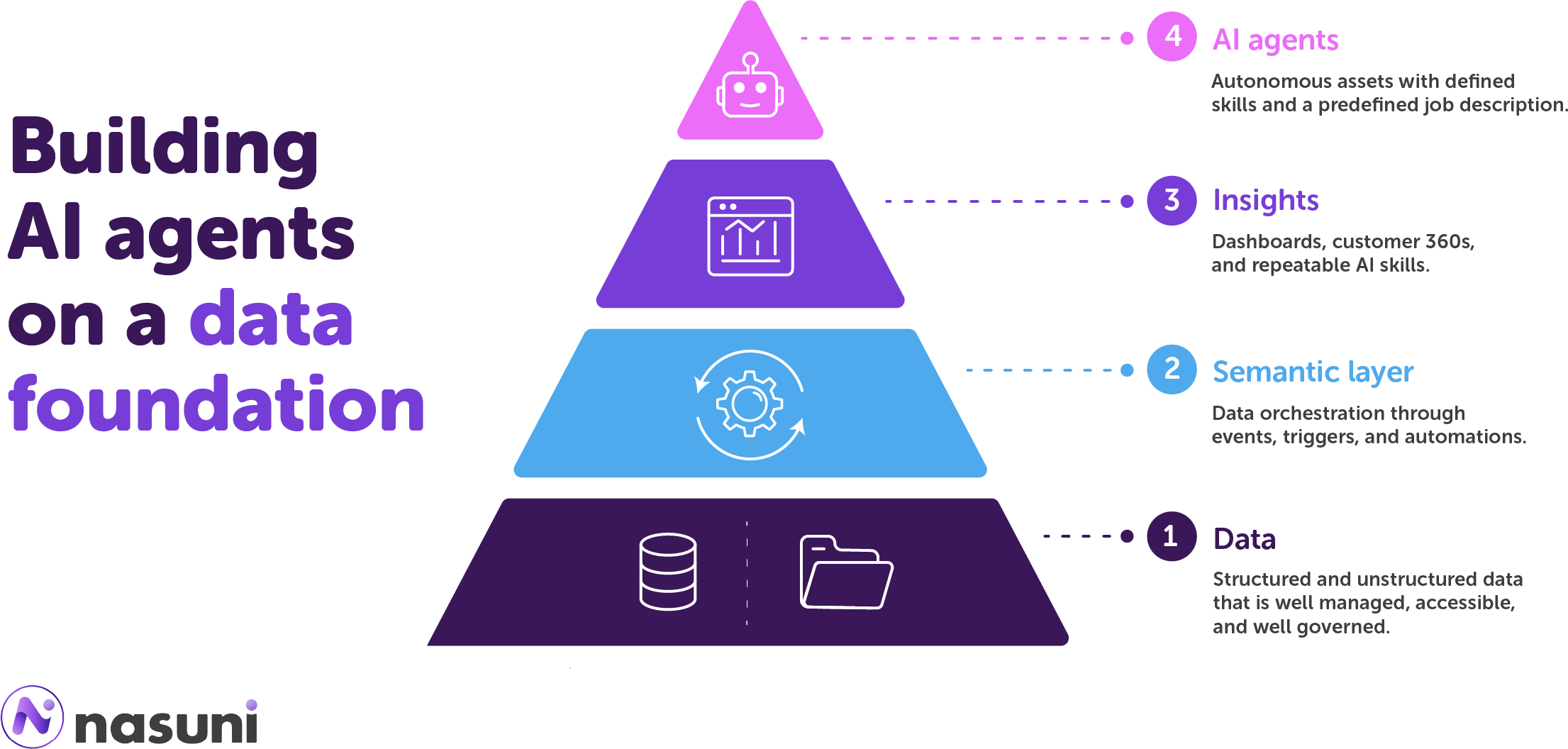
Earlier this year, we took it all back to core principles. I created a pyramid to help us think about agentic adoption more strategically:
- At the bottom is data, both structured and unstructured. We ensure that the data is well managed, accessible, and well governed.
- Next is the semantic layer. This is where we orchestrate data between systems with events and triggers that kick off automations.
- Above that are insights. This is where we create our own artifacts such as dashboards, customer 360s, and value proposition memos. We use the automation underneath to build specific, repeatable behaviors inside Claude or ChatGPT, called skills.
- At the top is the agent itself: an autonomous asset with a set of defined skills and behaviors, drawn from the layers beneath, built around a predefined job description.
Building from the bottom up, instead of rushing straight to the top, has helped us be more principled about how we build AI automation technology.
Q: What possibilities has this more principled approach opened up for your team?
The North Star that we’re working towards is an agent that does the work and proactively nudges the human user to take action. I think of this as the difference between a pull and a push dynamic:
Today, the way we use AI is mostly pull. We can get information and insights, but only when we reach out and ask for them.
Push is the agent doing the work overnight, sending you notifications. You wake up to a Slack message with your personalized book of business: risks, priorities, signals, reminders, and pre-drafted emails ready for you to act on.
Agents can do that work at a velocity that a human can’t.
Q: Which unstructured data management trends do you see becoming important in the next six-to-twelve months?
I love this question because I spend a lot of my time thinking about where the industry will go from here. Over the next year, I think we’ll see AI technology disappear.
Take web 1.0. Nobody talks about the evolution of web 1.0 anymore. It’s just there, accessible in every minute of our day, across every part of our lives.
The same is happening with AI. With OpenAI and Anthropic’s tools now so widely available, more of us are using them on a daily basis. Soon we’ll become so immersed that they’ll effectively disappear. I think we’re going to feel that especially in the commercial space compared to the enterprise space.
Q: What about the 3-5 year horizon? Do you have any unstructured data predictions for 2026-2030?
In the next two to three years, agents will start managing other agents and communicating cross-functionally in the business.
That will require a whole new management system. I call it Infrastructure 3.0. Within Infrastructure 3.0, observability becomes vital for two things: security and business.
On the security side, we need to be able to answer questions like:
- How do we detect abnormal agent behavior?
- When will the kill switch get activated?
- How do we stay ahead of bad actors?
As agents take on more managerial roles, we’re going to see less importance placed on the middle layer of management. That means building controls into the system to make sure that agents:
- Are compliant with company and regional policies
- Are performing their duties according to their job description
- Are communicating in line with the brand guidelines
- Have a structured improvement path to becoming an expert
To achieve that, we’ll have to monitor every conversation agents have, with humans and with each other. That all takes observability. I think we’re about to see that layer come alive.
Q: In this future where agents are managing agents, what are the people doing?
We’re going to evolve too. We’ll develop new skill sets to manage in organizations made up of blended human-agent teams. Span of control increases, because we can manage more with less. Human jobs won’t go away entirely, but they will shift. People will either move vertically up the org chart or become specialized domain experts.
And at the center of it all is data. Because every actor – whether human or agent – needs context to do their job. So that information has to be accessible, well governed, and well organized, because every entity will access it directly, rather than relying on institutionalized knowledge. The organizational context becomes more important than ever.
CIO Corner is the executive lens on what’s next in IT, delivered by Nasuni CIO, Dalan Winbush. With a firsthand perspective from the frontlines of IT leadership, Dalan unpacks what it really takes to modernize infrastructure, harness AI, and lead through complexity. This series tackles the hard questions CIOs face today, such as scalability, resilience, velocity, and value. It’s a candid look at how cloud and AI are reshaping enterprise IT — from someone who’s doing it, not just talking about it.
Related resources
August 27, 2026 | Nick Burling
Why We Acquired DryvIQ: Because You Can’t Build a Data Strategy on Data You Don’t Understand
Nasuni CPO Nick Burling talks about why Nasuni acquired DryvIQ.
Read more
August 19, 2026 | Dalan Winbush
What does AI-ready data management look like in practice? A Q&A with CIO Dalan Winbush
Nasuni CIO Dalan Winbush talks about separating hype from impact, avoiding common pitfalls when scaling AI, and building an AI-ready data management…
Read more
July 16, 2026 | Dalan WInbush
CIO Corner: The Data Hygiene Myth Most CIOs Still Believe
Nasuni’s Dalan Winbush explains why perfect data hygiene is a fantasy, and shares what CIOs should do instead to make their unstructured data agent-ready.
Read more