
/ Hardware Scarcity & Cost Pressure
File infrastructure without the hardware dependency
Enterprise hard-drive prices rose 46% in four months. NAND capacity is sold out through 2026. Nasuni runs as software on the cloud you already use — no controllers, no refresh cycles, no procurement surprises.




Software-defined. Cloud-native by design.
Nasuni isn’t a hardware vendor with a cloud add-on. It’s a fully software-defined platform built to run on the object storage of every major hyperscaler — turning your existing cloud investment into a global enterprise file system with built-in backup, DR, and ransomware protection. You pick the cloud. Nasuni delivers the file layer.
 +
nasuni
+
nasuni
Enterprise file services on the object storage you already use. Available in AWS Marketplace.
 +
nasuni
+
nasuni
Enterprise file foundation for Azure-first organizations. Available in Azure Marketplace.
 +
nasuni
+
nasuni
Enterprise file services powered by GCS. Available in Google Cloud Marketplace.
+
nasuni
Enterprise file services on Oracle Cloud Infrastructure.

No new procurement
Deploy Nasuni from your existing cloud marketplace. Use committed cloud spend you’ve already negotiated.

Zero refresh cycles
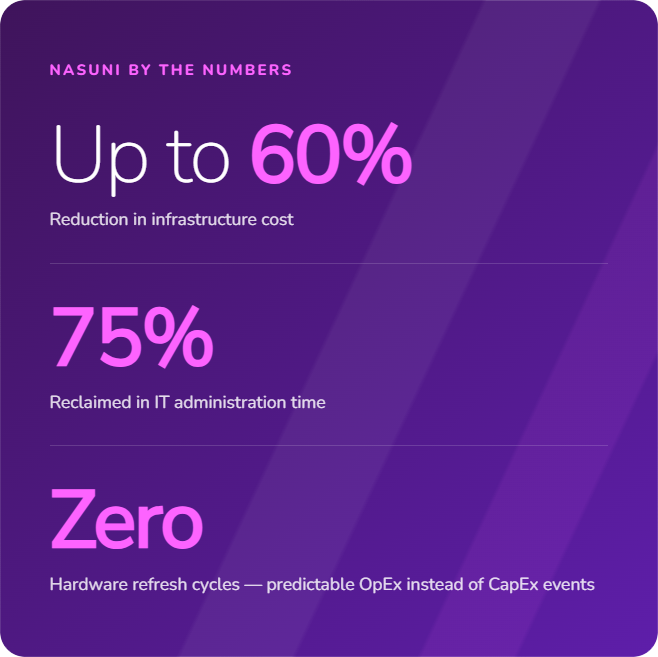
Software-defined means no controllers, no shelves, no end-of-life dates. Capacity scales at the speed of your cloud.

Your cloud, your security
Data lives in your tenant. Inherits your IAM, encryption keys, network controls, and compliance boundaries.
Structural, not cyclical.
Enterprise file storage ran on a predictable refresh rhythm for decades. Three forces broke it — and none of them are reversing.
-
1AI hyperscalers reallocated the supply. High-bandwidth memory consumes roughly 4× the wafer capacity of conventional DRAM, and NAND capacity is sold out through 2026. Source: Tom’s Hardware, January 2026
-
2Pricing inflated across the entire NAS stack. Enterprise hard-drive prices rose 46% in four months. Hardware estimates routinely arrive at 125–200% of expected figures. Source: Tom’s Hardware, January 2026
-
3Unstructured data accelerated past hardware. It now accounts for 80–90% of all new enterprise data, growing 55–65% annually — regardless of what’s available to put it on. Source: Gartner

Our financial people were particularly happy to see us move from a large cyclical CapEx model to a predictable month-to-month operational model. It was one of the few things I’ve done in thirty-four years that actually made the CFO smile.
Hardware-bound vendors can’t keep up.
The vendors still tied to hardware bring the same cost structure and complexity you’re trying to escape. Nasuni was purpose-built to eliminate that dependency entirely.
NetApp
NetApp’s hardware-bound architecture creates CapEx spikes, procurement delays, and per-site refresh planning. Nasuni eliminates the dependency entirely — cutting 5-year TCO by up to 63% with no forklift migration.
See the comparison →Dell PowerScale
PowerScale (EMC/Isilon) was built for was built for the data center: refresh cycles every 3–5 years, separate backup tooling, no real-time global file lock across sites. Nasuni delivers a single global namespace on cloud object storage — at lower cost, with built-in DR and immutable snapshots included.
See the comparison →Windows File Servers
On-premises file servers demand constant refresh cycles, separate backup tools, and growing management overhead at every location. Nasuni consolidates all of it — every site, every file, every snapshot — in a single platform with one global namespace.
See the comparison →Related resources

White paper
Beyond the Refresh: Why the NAS Model is Breaking for Good
Why hardware disruption, storage inflation, and AI competition are forcing a permanent rethink of enterprise file storage.
Learn more
April 29, 2026 | Sam King
Once in a Decade, Three Times in Ten Years: Isn’t It Time to Ask a Different Question?
Hardware price spikes and supply chain shocks are becoming the new normal. Nasuni’s CEO Sam King discusses how software-defined, cloud-native architecture…
Read more
Webinar
Beyond the NAS Refresh: An Executive Fireside Chat on Reducing Risk and Modernizing File Infrastructure
NAS refresh cycles are becoming more complex, costly, and unpredictable, pushing IT leaders to rethink how they manage, protect, and scale file data across…
Learn more