

“We’re building agentic AI upside down” Data governance Q&A with CIO Dalan Winbush
Nasuni CIO on why “What’s your AI strategy?” is the worst question, what terrifies him about AI data governance, and how CIOs can make every AI dollar pay off.
October 14, 2026 | Dalan Winbusg
To mark the launch of Nasuni’s File Data Platform expansion, including AI Activate, we sat down with Nasuni CIO Dalan Winbush. In this Q&A, he unpacks why “What’s your AI strategy?” is the wrong question to ask, what terrified him about building the internal prototype behind AI Activate, and the ROI framework he uses to make sure every AI dollar pays off.
Q: Before AI Activate was a product, it was a problem you were trying to solve internally. When you were building consensus to open file data to AI, whose buy-in was hardest to get?
My main problem wasn’t securing buy-in. It was pushing the brakes. Other teams wanted to move fast, give AI access to our file data, and see what it could do. That terrified me, because I knew that our environment was over-permissioned.
AI is just a big aggregator: it will show you everything and anything you let it access. The worst-case scenario would have been AI handing someone unauthorized access to the HR or legal folder. So the very first step, before we implemented it, was to lock down data access governance across the business, so that AI would only ever touch what it was supposed to.
The most resistance came from the people who understood the risk best: legal, IT ops, and my infrastructure team. They were holding back. And they were right to.
Q: Your internal AI data project became the product Nasuni now sells as AI Activate. What’s different about advising a customer to adopt it versus how you approached it?
A typical sales conversation starts with, “What’s your AI strategy?” But that’s the wrong question. There’s no value in throwing AI at everything unless it’s the right solution for the right problem. If you buy a hammer, you’ll go looking for a nail, when you don’t even know whether you’re building a house or hanging a picture frame.
When I advise customers on AI Activate, I start with a different question: Where are you in your AI journey? Then I stop and listen. Your board might be pushing you to ship AI fast, but it’s my job to make sure you know what you’re solving for, and that your data governance is already in order.
Q: For a CIO about to let AI agents query their file systems for the first time, what’s the one guarantee you’d insist on before trusting that access?
Governance. Full stop. It’s the foundation of any AI strategy. I’ve talked before about what I call my pyramid of agentic adoption.
- At the base is data and governance
- Next, orchestration and automation: deterministic, repeatable tasks
- Above that are the packaged, reusable skills
- And agents go right at the top
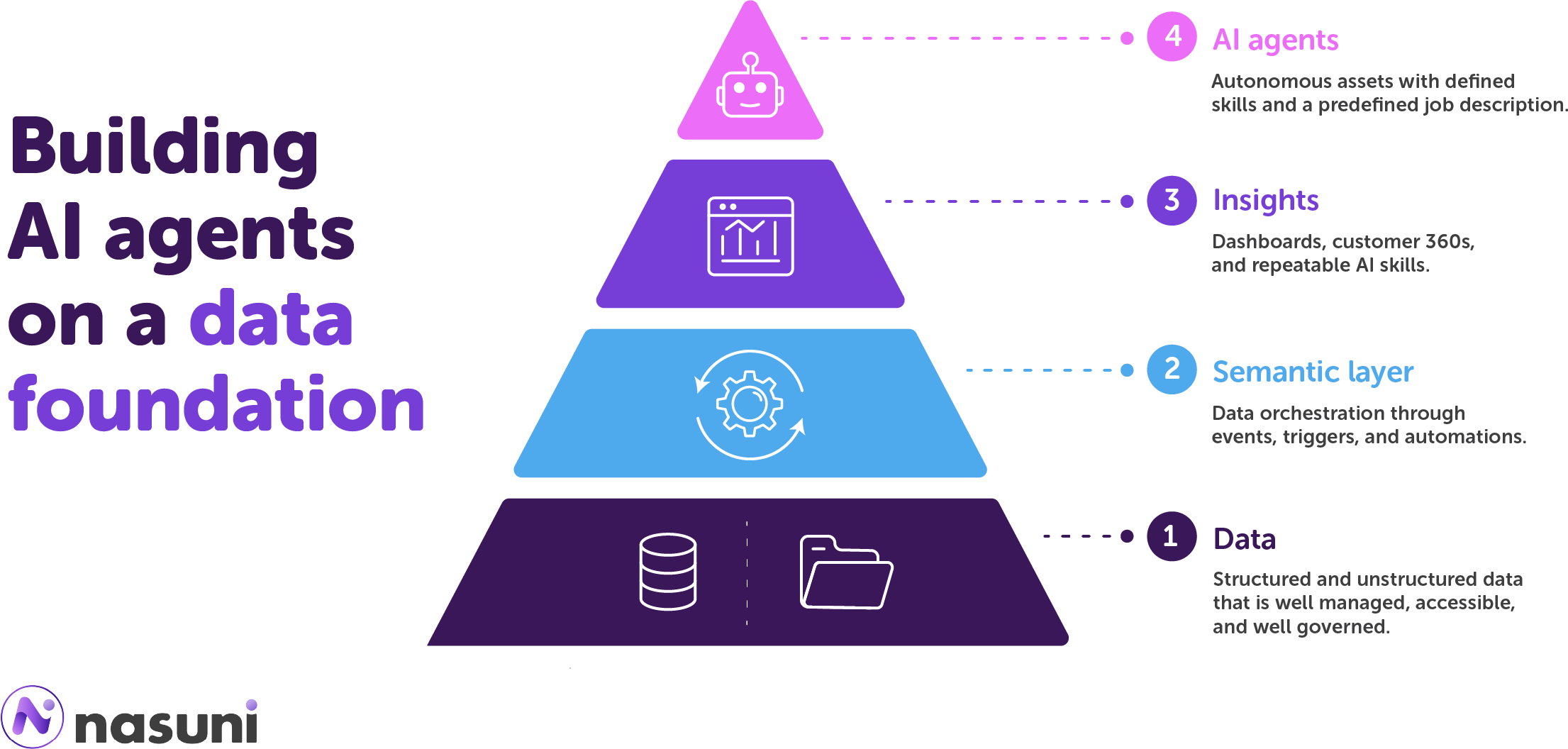
Too many organizations build the pyramid upside down. They’re chasing agents and neglecting data governance, because governance isn’t cool. But it’s the unsexy stuff that sets you up long term.
Q: What are the fundamentals of good data governance?
There are three pillars: permissioning, knowledge management, and accessibility.
Permissioning is controlling, who, or what, is allowed to view, use, and share files—and under which conditions.
Knowledge management is clarity, knowing exactly where your data lives, which version is your golden copy, and archiving what’s gone stale.
Accessibility, especially as it relates to unstructured data, is the one we often forget: Can the file be read?
You can have the right version, correctly permissioned, and perfectly catalogued, but if it’s in a cryptic format, then you won’t be able to read it. Neither will an LLM. This time last year, Claude couldn’t read a PowerPoint. Today, we drop in entire decks without a second thought and expect insight back.
Q: Your internal AI rollout went through five phases before reaching the whole company. What’s the one thing from that internal journey you’d tell a fellow CIO not to skip?
I’m working with Ross Grainger, our CFO, on the step that most organizations miss: AI ROI.
We’re building a framework to calculate the return on every dollar spent on AI. My personal rule is that every $1 spent should bring $3 back. We track that by looking at revenue against headcount. Most companies grow in size at the same rate as their revenue. Revenue up 20%. Headcount up 20%. That’s the old math. But we’re now seeing revenue increasing without teams growing at the same pace. That tells us that AI is helping people scale their impact and that the investment is actually paying off.
We know these tools are powerful. But with powerful solutions comes a significant cost. We need to implement them in a way that is economical.
Q: At what stage of the process should you be having the economics conversation?
Right at the beginning, at the ideation stage. We need to get back to basics. If you were buying Salesforce, you’d draw up a business case first. It shouldn’t be any different with AI. For every idea, ask:
- How much is this going to cost us?
- What do we expect to make back?
- What’s the impact on the business?
- What leading and lagging indicators will we measure?
When those conversations happen upfront, you can measure value through the whole process. At the pilot stage, find your leading indicators. Use them to build a hypothesis for scaling. That gives you a ground floor. Anything vertical from there is icing on the cake.
Q: What’s the one piece of advice you’d give a CIO who’s under board pressure to show AI progress, but hasn’t yet confirmed their unstructured data is governed and ready?
Your strategy shouldn’t start with AI. Your strategy should start with: How can I grow the business in a way no one else can? AI is restructuring and refactoring processes, fundamentally changing how work gets done. So think differently. What new problems can you solve? Which efficiencies can you multiply? What can you build today that wasn’t even an option two years ago? Those are the conversations CIOs need to be having with our constituents. Business conversations, not technology conversations.
CIO Corner is the executive lens on what’s next in IT, delivered by Nasuni CIO, Dalan Winbush. With a firsthand perspective from the frontlines of IT leadership, Dalan unpacks what it really takes to modernize infrastructure, harness AI, and lead through complexity. This series tackles the hard questions CIOs face today, such as scalability, resilience, velocity, and value. It’s a candid look at how cloud and AI are reshaping enterprise IT — from someone who’s doing it, not just talking about it.
Related resources

October 06, 2026 | Sam King, CEO, Nasuni
The Next Generation of Work Needs a New Generation of Infrastructure
Nasuni CEO Sam King explains why the next generation of work requires a unified, governed data foundation that empowers both enterprise teams and AI.
Read more
September 16, 2026 | Dalan Winbush
Which Data Management Trends Should CIOs Have on Their Radar? A Q&A with CIO Dalan Winbush
Nasuni CIO Dalan Winbush shares how he keeps up with unstructured data management trends and his predictions for the future of the data infrastructure…
Read more
August 19, 2026 | Dalan Winbush
What does AI-ready data management look like in practice? A Q&A with CIO Dalan Winbush
Nasuni CIO Dalan Winbush talks about separating hype from impact, avoiding common pitfalls when scaling AI, and building an AI-ready data management…
Read more