

What does AI-ready data management look like in practice? A Q&A with CIO Dalan Winbush
Nasuni CIO Dalan Winbush talks about separating hype from impact, avoiding common pitfalls when scaling AI, and building an AI-ready data management foundation.
August 19, 2026 | Dalan Winbush

Every enterprise IT leader wants to be AI-ready, but many are finding that the bottleneck isn’t the capability of the models, but the state of the data they’re working with. In this Q&A, Nasuni CIO Dalan Winbush shares how he separates AI hype from AI impact, the most common pitfalls organizations encounter when scaling AI, and what it takes to build a truly AI-ready data management foundation.
Q: There’s a lot of buzz right now about how AI is improving data management across the enterprise. From your perspective, what’s real and what’s still hype?
The hype curve is flattening out fast, and the best way for CIOs to figure out where they are on it is to get back to basics and evaluate measurable impact. How is AI improving data management in the business? Are we getting value out of our AI spend or overrunning OPEX because token utilization is going through the roof? Are we solving the right problems and measuring the right outcomes? It’s that combination of technical feasibility, financial feasibility, and the efficacy of the solution that endures beyond hype cycles.
Q: Where do you see enterprises getting tripped up most when they try to scale AI?
In two words: data governance. But there are three pillars underneath that.
First is poor knowledge management, which is a 90-year-old problem. Unmarked, untagged unstructured data can’t be used intelligently by AI. Second is poor security. Over-permissioning can lead to AI mistakenly exposing sensitive financial data or PII to the general population. Third is poor data quality. The old saying “Garbage-In-Garbage-Out” applies now more than ever because AI is revealing piles of garbage we’d forgotten we had.
I also think people misunderstand what it takes to scale. Scaling is doing something that’s repeatable. You start with a test group of 10 people, then scale to 50, then to 100, then 1000. And you’ll learn something different with each cycle. Rolling out an application to 150,000 people in your organization overnight isn’t scaling. That’s just uncontrolled deployment.
Nasuni just created an MCP server, where we built a new data warehouse with a semantic layer that’s humanistic, so any actor – human, system, or agent – can ask a plain-English question and get a real answer in seconds. It knows about product usage, storage capacity, platform health, and even what’s been said on calls. We released that to multiple small groups, collected feedback, and made adjustments. We learned so much in that process: How do we set expectations? What does our change management look like? What is the roadmap? We went through five different phases and released it to the company last month.
Q: We hear the term “AI-ready” everywhere now. What does a truly AI-ready data management foundation actually look like in practice?
I’ve changed my mind a few times about what AI-ready data management looks like because the market is moving so fast. All the LLMs are coming out with new capabilities every few weeks. But right now, I think it has three components:
First is an underlying architecture that’s stable and sustainable enough to absorb the inevitable turbulence of the market. The best AI data management solutions give you the built-in flexibility to either consume or adjust to new developments.
Second is good data health and governance. Good data hygiene is the foundation for a strong and sustainable AI strategy. That includes both structured and unstructured data; both data that’s at rest within your systems and in your data warehouses. You need full visibility over your data estate to understand the gap between your current hygiene and where you need to be, and how to bridge it.
Those elements make up your technical readiness. But, as with any transformation, there’s also a significant change management piece. The two cannot be separated. So you have to consider the experience for the end user: What can the AI product do for them? How do they get started using it? Can you give them some ready-made prompts to introduce the core use cases?
Everyone has a different level of experience and comfort with AI and LLMs. It’s my job to bring the person who has just joined the organization along with us on the journey without slowing down the power users. Because even the most technically excellent AI product will never get used if your people don’t see the value in it.
Q: You’re in the middle of building a lot of this right now. What’s the thing you’re most excited about that enterprise CIOs will be able to do in the next 12 to 18 months that they can’t do today?
I’ve spent the last 15 years talking about the democratization of technology: bringing the technology closer to the business, to the end user, and to the people on the ground who are solving day-to-day problems. I think we’re now in an era where that democratization is real.
Natural language is the new programming language, so you don’t need to be a technologist to get access to insights that help you make better decisions about how to run the business
The kind of questions that would have taken five analysts ten days to answer, the C-suite can now get to in minutes:
- What trends in customer behavior should I be paying attention to?
- What patterns are emerging in our product adoption?
- Which market dynamics might impact us in the next quarter?
Sam King, our CEO, can get intelligence – and act on it – from her desk. The most exciting part about that isn’t the technology itself, but the capabilities it’s giving us to improve business efficiency, to accelerate, and to scale.
CIO Corner is the executive lens on what’s next in IT, delivered by Nasuni CIO, Dalan Winbush. With a firsthand perspective from the frontlines of IT leadership, Dalan unpacks what it really takes to modernize infrastructure, harness AI, and lead through complexity. This series tackles the hard questions CIOs face today, such as scalability, resilience, velocity, and value. It’s a candid look at how cloud and AI are reshaping enterprise IT — from someone who’s doing it, not just talking about it.
Related resources

July 16, 2026 | Dalan WInbush
CIO Corner: The Data Hygiene Myth Most CIOs Still Believe
Nasuni’s Dalan Winbush explains why perfect data hygiene is a fantasy, and shares what CIOs should do instead to make their unstructured data agent-ready.
Read more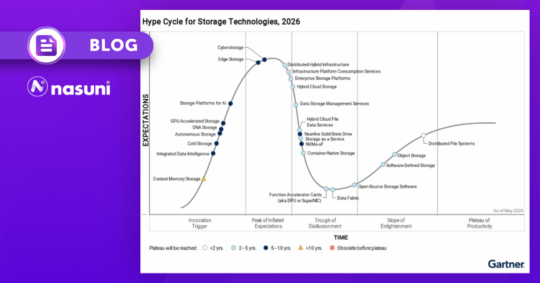
July 02, 2026 | Parag Pathak
Four Signals, One Foundation: What Gartner’s 2026 Storage Outlook Means for Your Data
The Gartner® Hype Cycle™ for Storage Technologies, 2026 points to four critical signals for IT leaders that add up to one strategic decision.
Read more
June 16, 2026 | Dalan Winbush
CIO Corner: Claude’s New Models Mean the End of BI as We Know It
Nasuni’s Dalan Winbush shows how Claude’s interactive artifacts are collapsing the distance between data and decision — and what it means for BI teams.
Read more