

The Nasuni Connector for Splunk: Ransomware Alerts Where Your SOC Already Works
The Nasuni Splunk integration sends ransomware detection alerts, antivirus events, snapshots, and audit events into your SIEM data.
November 12, 2026 | Ramin Rouzbeh, Sr. Director of Product Management – Integrations

90%+ of organizational data is unstructured, according to McKinsey. It’s the files, drawings, contracts, and models a business runs on, and it’s what ransomware encrypts. So how much of it can your Security Operations Center (SOC) see?
SOC teams are increasingly looking to unify infrastructure telemetry, security intelligence, and operational workflows into a centralized observability and security information and event management (SIEM) platform. File data belongs in that view too, especially as hybrid cloud file environments grow. The ability to operationalize file data activity within existing security operations has become a critical requirement.
Nasuni, the Operational File data Platform for the AI era, protects that file data. Nasuni Ransomware Protection handles ransomware detection where your teams open and save files, and can trigger mitigations when they find an attack.
The Nasuni Connector for Splunk, now available on Splunkbase, sends both the detections and the mitigations to Splunk Enterprise and Splunk Cloud environments. Your SOC’s view now includes file activity, next to its endpoint, identity, and network signals, in the tool it already uses. The sooner an alert reaches an analyst, the sooner they can act on it.
How the Nasuni Splunk integration works
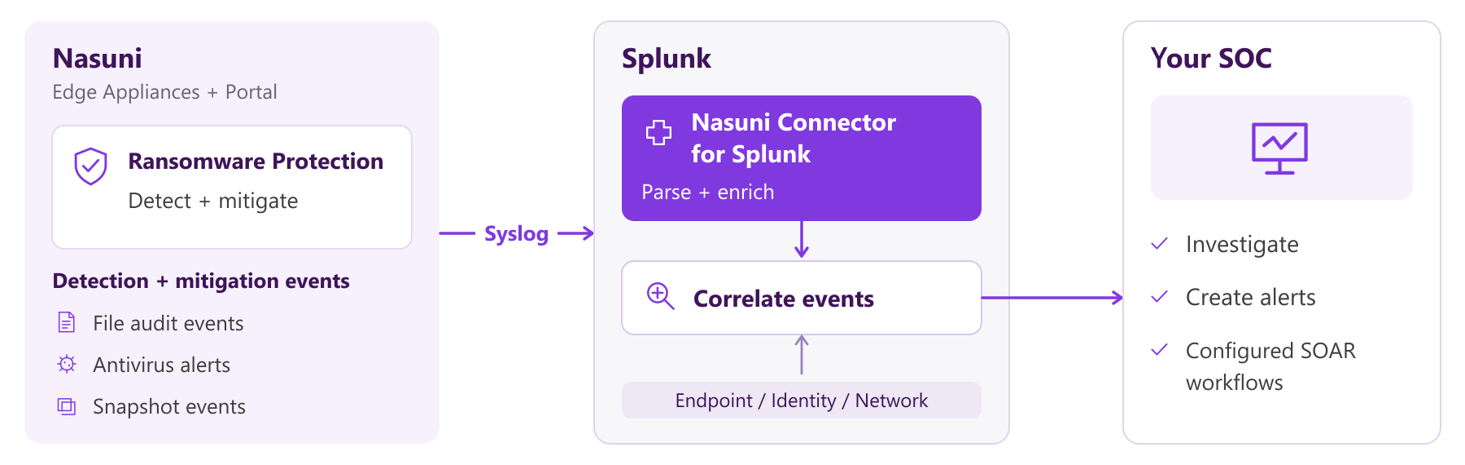
The integration delivers centralized visibility into Nasuni file activity, including ransomware alerts, antivirus events, snapshot operations, and file system audit event data originating from Nasuni Edge Appliances and the Nasuni Management Console (NMC). By transforming syslog telemetry into searchable and actionable Splunk events, organizations can accelerate incident response, improve audit readiness, and strengthen overall cyber resiliency.
Many security teams have already built their SOC workflows around Splunk, from SIEM pipelines to automated response frameworks. As organizations continue to prioritize ransomware preparedness and insider threat visibility, the Nasuni Connector for Splunk enables file infrastructure intelligence to become part of established security operations and security orchestration, automation, and response (SOAR) processes, allowing security teams to correlate storage-related activity alongside endpoint, identity, and network telemetry within a single operational view.
Putting Nasuni Ransomware Protection to work in the SOC
Nasuni Ransomware Protection, an add-on to the Nasuni File Data Platform, detects ransomware at the edge, where users work, and can trigger mitigations when it does. The Nasuni Connector for Splunk sends both the detections and the triggered mitigations to Splunk, where they are parsed, indexed, and enriched for search and correlation. Your security team sees what was detected and what Nasuni did about it, without checking the Edge Appliance or the NMC.
Ransomware rarely announces itself in one place. A suspicious pattern on a file share is far more useful when an analyst can see it next to the endpoint, identity, and network signals around it. Because the events are enriched for correlation and downstream SOAR workflows, teams can build searches, alerts, and automated responses around file data activity.
The rest of the connector’s data adds context. File system audit events record file-level access, modification, and deletion, so an analyst investigating a ransomware alert can see the file activity around it. Snapshot success and failure events show whether protection is current, and a failed snapshot during an incident is something a responder wants to know right away. Together, with immutable snapshots and rapid recovery, that gives the SOC what it needs to handle a ransomware event that is recoverable in minutes. That speed matters. According to the State of Enterprise File Data 2026 report, 70% of enterprises took more than a week to recover from a cyberattack.
Make file data part of your SOC’s view
File data is what ransomware typically goes after, and it shouldn’t be the one place your SOC can’t see.
Publishing the Nasuni Connector for Splunk on Splunkbase simplifies adoption and makes it easier to bring Nasuni event data into existing security operations. For organizations focused on stronger cyber resilience, Nasuni offers a platform that integrates with the technologies already deployed across your environment. Nasuni protects file data where work happens. With the connector, your SOC sees what Nasuni detects.
Get the Nasuni Splunk integration
Want to learn more about bringing file data into your SIEM? Explore the Nasuni Connector for Splunk details:
Nasuni Connector for Splunk on Splunkbase
Ready to take the next step? Review the implementation and configuration documentation:
Related resources

May 07, 2026 | Scott Gass
When One Click Can Cost Billions: Lessons from a Modern Cyberattack
Nasuni’s Scott Gass discusses how Zero Trust and data-layer resilience are essential to containing cyberattack impact and enabling rapid recovery.
Read more
October 06, 2026 | Sam King, CEO, Nasuni
The Next Generation of Work Needs a New Generation of Infrastructure
Nasuni CEO Sam King explains why the next generation of work requires a unified, governed data foundation that empowers both enterprise teams and AI.
Read more
June 30, 2026 | Matt DeJohn
Beyond Data Recovery: Why the Best Customer Outcomes Start with Empathy and Action
What does real business resilience look like? For Nasuni’s Customer Success team, it starts with empathy in action and showing up when customers need it…
Read more