
Five Industry 4.0 Challenges Nasuni UniFS® Solves for Manufacturers
Your factory generates more data than ever. Here’s how Nasuni UniFS® turns five common Industry 4.0 file data challenges into a competitive advantage.
June 11, 2026 | Daniel Zrubek, Sr. Solutions Engineer, Nasuni
Industry 4.0 is changing the way manufacturers design, build, and distribute products. Interconnected, intelligent production systems can accelerate product lifecycles and revenue streams.
The problem? Operational data continually evolves, but your legacy NAS was designed for a static world.
Integrating every file from design offices to factory floors generates an explosion of unstructured data. Traditional storage creates friction that can strip smart manufacturing of its potential. Here are the five biggest challenges to plan for and how we solve them for manufacturing companies.
The five biggest Industry 4.0 data challenges for manufacturers
1. Exponential, unrelenting data growth
IoT sensors, CCTV, laser imaging, and automated inspection systems can generate up to 10 TB of data per line, per day. Multiplied across your network, that’s petabytes of unstructured data piling up each year.
Factor in increasing sensor density, inspection resolution, and digital twin programs and it’s clear: hardware storage can’t keep up. Capacity fills too fast. Older data gets deleted, destroying historical records essential to trend analysis and model training. Infrastructure teams spend time on capacity when they could be enabling AI to surface process-optimizing insights.
Nasuni solution: An instant bridge to unlimited capacity
We pair your choice of cloud object storage (AWS S3, Azure Blob, or Google Cloud) with the file protocols (SMB, NFS, S3), security, and global access controls your teams already rely on. You absorb mass data volumes at cloud economics without giving up the file experience. Projects that once created a capacity crisis can now be added without procurement, hardware installation, or provisioning.
New sites spin up in hours, not months
Forget exhausting integrations and delayed value. We deploy a virtual edge appliance that connects to your existing global namespace, automatically inheriting access controls and policies. Swift integration means active M&A projects, and rapid greenfield expansions achieve ROI faster.
Multi-cloud flexibility works around you
4.0 technology stacks are not monolithic. Cloud-agnostic flexibility is crucial to data-driven collaboration and production enhancements. We deliver a consistent file experience on top of whatever object storage best fits your strategy, whether it’s a third-party solution or private cloud. As priorities shift, you can change your underlying provider without affecting how teams access their files.
2. Multi-site distribution and collaboration latency
Globally distributed collaboration is painfully slow. For example, CAD assemblies replicate large files between sites using WAN optimization tools that can stretch for hours. Meanwhile, teams work from different versions. The subsequent conflicts, rework, and delays erode productivity.
Nasuni solution: Unified global namespace
Our file data platform deploys edge appliances with local caching to deliver LAN-speed performance at every site while quickly synchronizing data in the background. Instead of high-latency WAN links using SMB/NFS/S3, data is accessed locally, and changes are written to the cloud without manual transfers or duplicate storage. The unified global namespace scales to unlimited petabytes, not the single-petabyte ceiling typical of legacy NAS platforms, so multi-site operations don’t fragment their data foundation as they grow.
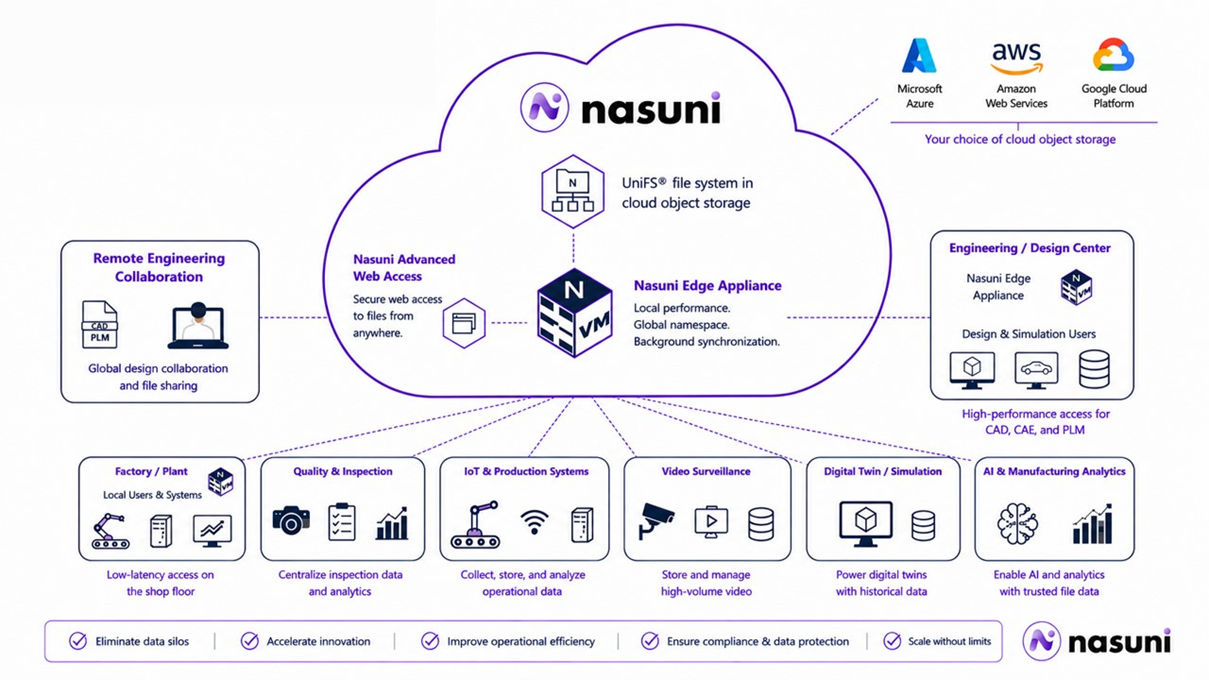
Integration with leading PLM systems such as Teamcenter allows teams in different regions to work on the same datasets without delay. By shortening PLM sync from hours to minutes and removing replication lag, version conflicts, and site-specific access constraints, you fix the largest friction points in engineering and quality workflows.
3. Escalating cyber threats
Manufacturing is a prime target for ransomware, accounting for approximately 75% of all attacks. It’s likely due to high-connectivity environments and historically inadequate cybersecurity investments.
But most of all, bad actors know you’ll be motivated to get back online.
Threats will only get worse. Every new sensor, machine controller, and integration point could be a soft spot. Recovery for traditional backup systems can take weeks, and events that affect multiple sites routinely rack up millions of losses in downtime, recovery, and reputational damage.
Nasuni solution: Built-in security and rapid recovery
Nasuni Ransomware Protection sits where attacks begin: the edge. Anomalous write patterns trigger alerts before infiltrations reach your golden copy in the cloud, and our platform automatically blocks the offending user and client to contain the spread before it reaches other sites. Alerts stream to your SIEM so security operations can correlate Nasuni events with the rest of your environment.
If a breach does occur, immutable snapshots provide a complete, unencrypted recovery point as recent as one minute before the attack. Rapid restoration brings affected volumes back online in minutes, rather than the days or weeks typical of legacy backup systems. When production halts can cost up to $500K per hour, that speed is the difference between minor incident and existential crisis.
Clear access controls and audit trails
As Industry 4.0 environments introduce complex access patterns, stronger oversight and universal encryption close potential governance gaps. We make it easier to manage access and audit every read, write, delete, or permission change. Full content logs and our certifications in ISO 27001, SOC 2, CSA STAR, and HIPAA Security Rule help support broader compliance programs such as NIST CSF, CMMC, and GDPR.
Resilience beyond ransomware protection
Hardware failures, network outages, power events, and natural disasters can all interrupt access to data stored on on-premises equipment. Because our platform keeps golden sources in the cloud, a failed edge appliance gets replaced in minutes by a virtual one. No lost data, no extended downtime.
4. Integration complexity and the AI readiness gap
The defining promise of Industry 4.0 depends on the ability to connect and process operational data at scale. It’s where legacy storage creates its most insidious, invisible constraint.
Consider an AI platform that ingests data from 20 factory sites. With hardware, that’s 20 pipelines with their own connectivity, authentication, normalization, and maintenance overhead. Since traditional NAS was never designed to serve as an enterprise data foundation, each site’s NAS becomes a silo.
Data engineering teams will spend more time on plumbing, less on analytics. Model training pipelines won’t run continuously. AI ROI will drag.
Nasuni solution: Activate AI on your file data
Nasuni AI Activate (available Q3 2026) extends the foundation of a unified global namespace to AI agents and large language models through a hosted Model Context Protocol (MCP) server. Copilot, Claude, ChatGPT, and similar tools can search, discover, and reason over your manufacturing file data without separate pipelines or duplicate copies.
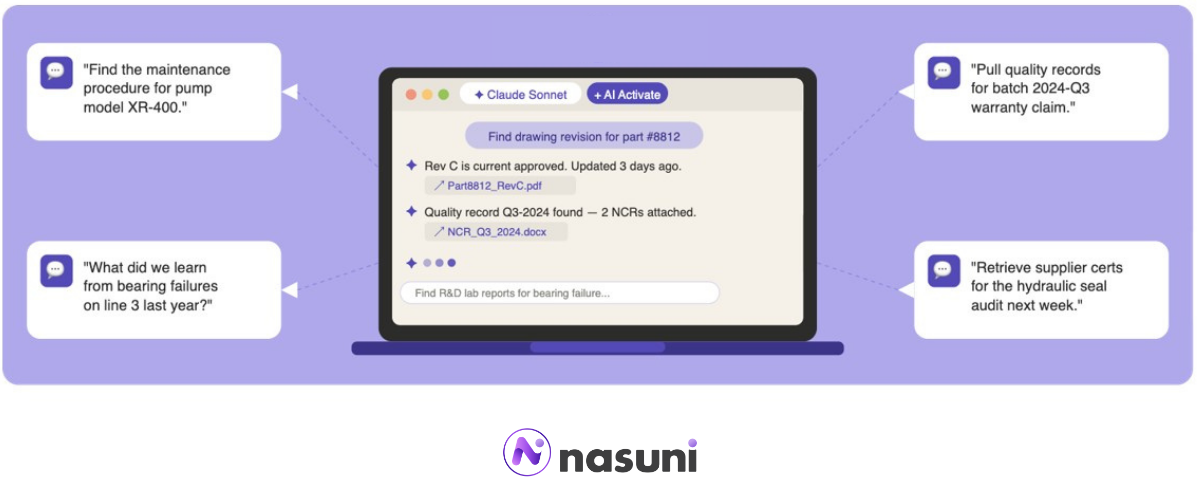
Three properties make this ideal for manufacturing. First, AI Activate enforces existing file-level permissions. Users and AI tools only see what they’re authorized to see, which is critical for datasets that span supplier IP and operational data. Second, we continuously index file content and metadata at petabyte scale, keeping AI context aligned with the current state of the data. Third, no data leaves the platform. Your golden copy stays as is; AI tools query through the MCP server. Critically, none of this requires in-house development. AI Activate builds the contextual index on top of your existing permissions automatically, so you connect AI to your file data without engineering the integration or rebuilding access controls yourself. Cross-plant training datasets and operational queries that used to require a data engineering project become a simple prompt, with answers grounded in trustworthy files.
5. The hidden cost of hardware inertia
Beyond the primary challenges, legacy storage imposes a subtler, but significant cost: it slows the pace of transformation itself.
Every Industry 4.0 initiative requires additional storage capacity. Hardware lead times of 8-16 weeks (or longer) introduce a structural lag between strategy and execution. IT teams become bottlenecks as your timeline doubles from 5 years to 10, plus compounding competitive cost.
Nasuni solution: Zero-downtime, incremental migration
We let you transform without upsetting day-to-day tasks. The move from on-premises arrays and remote servers to the unified cloud happens in the background as files remain accessible at their existing paths. You grow at your pace—minus the frustrating cutover windows, maintenance freezes, and loss of access that slow production.
Get ready for Industry 4.0 with Nasuni
For more on how we manage, protect, and activate enterprise file data for Industry 4.0, contact our experts or learn more about unified file data for modern manufacturing.
Related resources

May 05, 2026 | Nasuni
Why Storage Predictability Is Now a Board-Level Issue — And What Forward-Looking Organizations Are Doing About It
Enterprise leaders share how rising costs, unpredictability, and AI demands are forcing a rethink of storage infrastructure—and what comes next.
Read more

Request a TCO assessment
Compare the costs and benefits of Nasuni to any other alternative .
Learn more