
How Nasuni Accelerates R&D Business Transformation
Ryan Miller discusses how the Nasuni File Data Platform enables customers with R&D business use cases and more.
January 13, 2026 | Ryan Miller
When I talk with partners or prospective customers, it can be easy to simply deliver the standard pitch of what Nasuni is, and what we do from a technical perspective.
The challenge with this approach is that it’s heavily Nasuni-centric. It relies on the assumption that the listener and I share enough knowledge for my message to resonate — an assumption I know, from experience, doesn’t always hold true.
That’s why, whenever possible, I like to use real-world examples. In this post, I thought I’d do the same: take a closer look at a recent customer scenario where Nasuni was implemented. This particular customer is a global leader that applies science and creativity to develop innovative solutions for a range of industries, including food, beverage, personal care, and pharmaceuticals. Their goal was to accelerate revenue and speed time to market by enabling faster sharing of device data across global R&D sites — ultimately maximizing the high-value time of their scientists and engineers. They also aimed to simplify administration and eliminate single points of failure.
These challenges are not isolated. In fact, they are symptoms of four broader themes that many enterprises are wrestling with today, and they map directly to the four pillars where Nasuni delivers the most value: Cost Optimization, High Performance, Built-In Resilience, and AI Readiness.
Before Nasuni
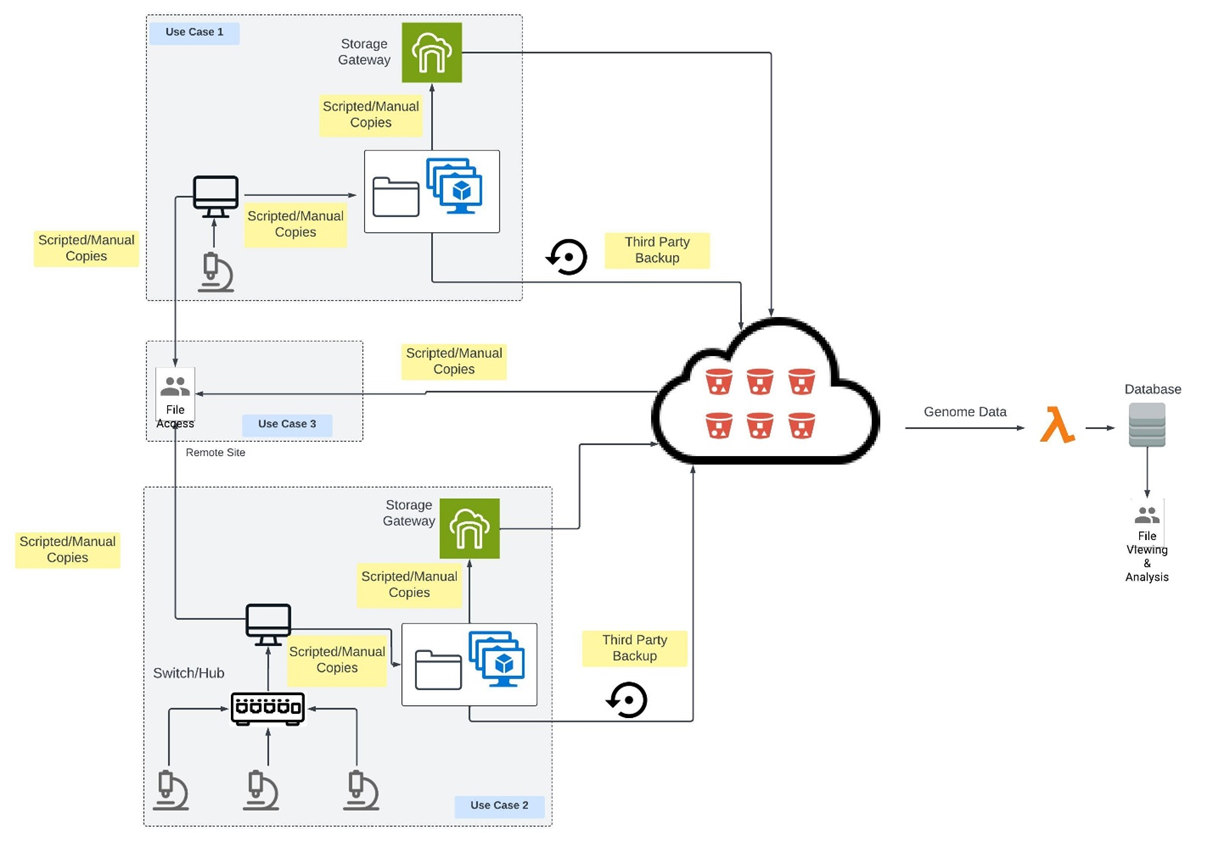
The above image shows an architecture diagram for what the customer had in place when we started working with them. There is a lot going on, so I’ll break it down here:
- Instrument data is generated at remote sites, where it was copied via scripts or a manual process to a virtualized local file server (use cases 1 & 2).
- From that local file server, it was copied again to a storage gateway, where the data was ultimately written to a dedicated bucket in the cloud.
- A third-party backup utility would copy the data from the local file server and write the data to yet another dedicated bucket in the cloud.
- Data was read from the cloud-based bucket(s) and fed into a Lambda function, where the result was fed into a database for additional viewing and analysis.
- Meanwhile, if an additional remote site needed the data available for access by users, the data was copied via scripts or manual process from the bucket to that remote (use case 3).
With Nasuni
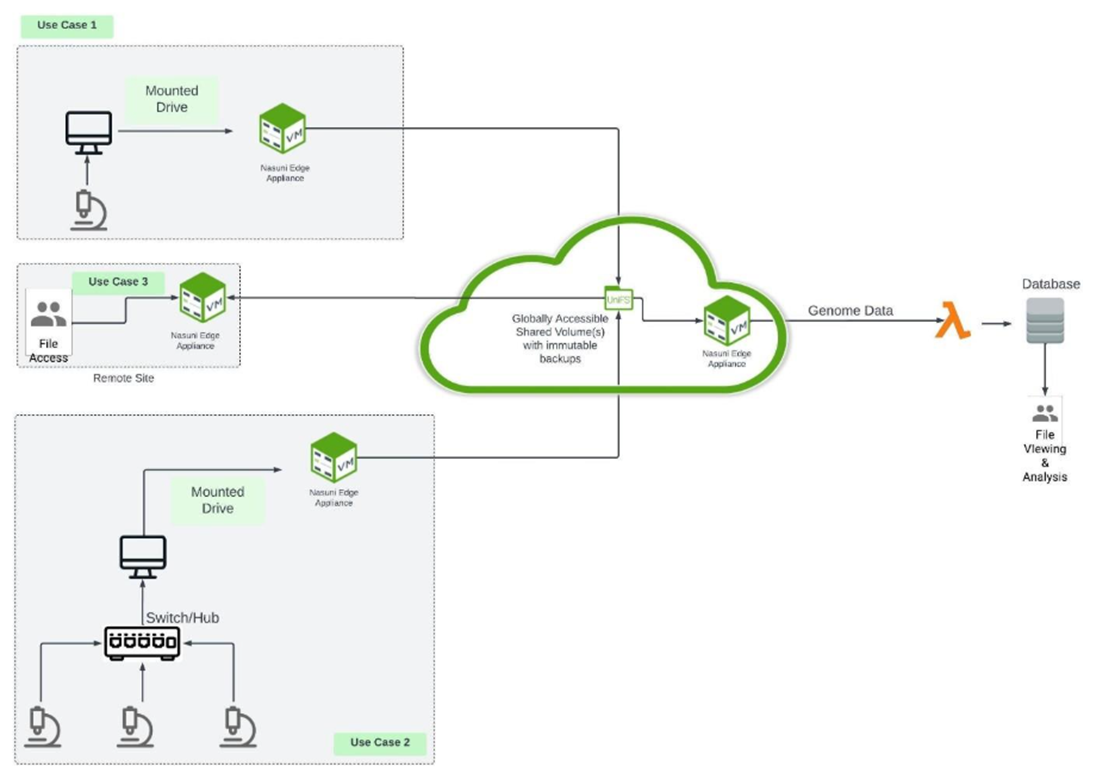
Nasuni simplifies all the busy and complex back-end coordination that was previously required. The above image shows the architecture once Nasuni was implemented. Once again, there is a good amount going on! A break down is helpful, along with how each piece fits into the value pillars:
- Virtualized Windows File Servers and 3rd party backup utilities were replaced with virtual Nasuni Edge Appliances.
- Built-In Resilience
- Fewer moving pieces and reduced maintenance points
- Built-in data protection
- Cost Optimization
- VMware core count reduction
- Reduced disk capacity requirements
- 3rd Party backup capacity licensing
- Built-In Resilience
- Scripted/manual copy operations were replaced by Nasuni’s scheduled snapshots and global file system.
- Built-In Resilience
- Eliminate need to maintain custom, in-house built scripts
- New data written to durable object storage within 5-15 minutes
- High Performance
- Data availability when needed by employees vs reliance on a manual copy process
- Built-In Resilience
- Many disparate S3 buckets were replaced with UniFS, providing consolidated access to underlying object storage.
- Cost Optimization
- Reduced duplication of data reduces storage expenditure
- AI Readiness
- Cloud based Nasuni Edge Appliance provides access to all data for AI tools to leverage, similarly to the Lambda function.
- Cost Optimization
Bringing It All Together
What began as a collection of point solutions built on home-grown scripts has now become a unified workflow with Nasuni. It’s not simply about replacing pieces of infrastructure — uncertainty, complexity, and manual effort are giving way to clarity, consistency, and predictability. This shift reflects the true value of Nasuni, which goes far beyond a straightforward per-terabyte storage comparison. The conversation becomes less about what Nasuni does and more about what it enables across the organization. In this case, the enterprise-grade approach delivers a speed-of-business advantage that a home-grown solution simply can’t match.
A Foundation That Frees Your Focus
While not overtly stated, one of the most significant benefits here is not just overall efficiency. It’s attention. The mental bandwidth required to maintain home-grown scripts or manually move data from point A to point B is enormous, and every one of those tasks demands focus from employees, the organization’s most precious resource. Yes, cost savings can appear as hard dollars, but IT efficiency shows up in fewer moving parts; data resiliency shows up as confidence that nothing will slip through the cracks; and employee productivity emerges when teams can shift their focus from babysitting systems to driving real business transformation.
Modernizing the foundation modernizes everything built on top of it.
Tech: Distilled gets to the heart of today’s file data challenges without the fluff. In this series, Ryan Miller, Senior Solutions Architect at Nasuni, unpacks complex technical concepts with sharp insight and real-world relevance. From data security and file locking to the building blocks of a unified file data platform, it’s the kind of practical knowledge that sticks. If you want your tech smart, clear, and just a little bold, this series is for you.
Related resources
November 04, 2025 | Ryan Miller
Preserving IT’s Most Precious Resource
Nasuni’s Ryan Miller discusses why attention, not time, is the most important resource for IT implementation teams.
Read more
August 21, 2025 | Ryan Miller
Architecting for S3 at the Edge: Doing it Right
Ryan Miller discusses how Nasuni’s S3 at the edge delivers full SMB and NFS support with built-in data protection and cloud-native scale.
Read more